

Since my earliest years, I have been driven by a unifying and persistent impulse: the desire to understand and to create novel combinations. This impulse has underpinned my interest in a variety of ostensibly unrelated fields, from natural science, to philosophy and the creative arts, music foremost among them. I’ve wanted to articulate this motivation for some time, since I’ve often found it’s rather different to the reasons for which people tend to pursue creative arts; for instance, self-expression, emotionality, narrative storytelling or simply to impress.
For me, the underpinning motivation behind my pursuit of philosophical clarity, (modest) scientific understanding and artistic experimentation is essentially the same, and there is (for me), therefore, little distinction between these various domains. In illustrating why, I hope to demonstrate the way in which the arts and sciences, and other forms of human understanding and creativity, share commonalities in their foundational epistemic and methodological structure.
At their core, art and science are both underpinned by what I will term ‘Analysis and Synthesis’, which can perhaps best be understood by considering the etymology of the given words. ‘Analysis’, we derive from the Greek “analusis”, to “break up”, “loosen” or “unravel”, and ‘Synthesis’—also of Greek origin—from “syn-tithenai” (ultimately entering into Latin as “synthesis”), or “putting-together”.
In art, science, conceptual analysis, language and much else, we analyse things by breaking them apart into their components and isolating their independent constituents, parameters and dimensions. Having done so, we are then in a position to recombine or synthesise their elements to produce novel forms, arrangements and patterns.
Von Förster on Science and Systemics
In this regard, my own thinking has been significantly influenced by the 20th Century Austrian cyberneticist Heinz von Förster, whose remarks on science offer an illuminating perspective on this process. (See video below. Timestamp: 1:22)
Von Förster characterises ‘science’ in much the same way as I have characterised ‘analysis’, noting that ‘science’ contains the root ‘sci’, also found in ‘schism’ and ‘schizophrenia’, meaning to ‘split’, ‘cut’ or ‘divide’. This is because in developing our scientific understanding, we are aiming for ever-greater levels of distinction between constituent elements of nature. We can see this at play in particle and quantum physics, for instance, which attempt to divide the world into its most base components, fundamental particles or ‘quanta’; the most elementary, discrete and indivisible components of nature. Von Förster furthermore proposes that much of what we call ‘science’ today has moved on from this original pursuit to what he calls ‘systemics’, or the holistic modelling of systems whose components are already understood; for instance, in weather systems, electrical circuits, computation, or—in von Förster’s own field of cybernetics—informational and biomechanical systems.
Synthesis as Combinatory Rearrangement
In addition to ‘science’, ‘systemics’ or ‘analysis’, I think we can benefit from the related notion of ‘synthesis’ specifically in order to refer to the process of combination given pre-analysed (pre-broken down or divided) elements. If you’ll forgive a rather banal example, for illustration:

Any given form, such as Figure 1), can be broken down into constituent components, to varying degrees of granularity. Ultimately, we could break down the components into imperceptibly small constituents, such as pixels, or particles, but at the relevant perceptive scale, we might break down the components into, perhaps, something like Figure 2). The level of granularity is not particularly important, but as we can see, any given analytic scale will present a field of possible recombinations; what I will hereafter refer to as a ‘possibility-space’. Assuming the baseline of granularity in Figure 2), we could say that we have a possibility-space of 24; 24 possible recombinations of the elements, of which Figures 3) and 4) are examples. Within a given possibility-space, we are then in a position to synthesise novel combinations.
Synthesis in Materials and Molecular Science
Synthesis, understood as combinatory rearrangement, manifests across multiple domains, often in structurally similar ways even when the medium differs. The same process of analysis and recombination appears in the physical sciences, particularly in molecular chemistry and materials engineering. Molecular synthesis is, at base, the deliberate recombination of pre-analysed atomic constituents into new configurations with targeted properties. Chemists treat atoms and functional groups as a finite set of components within a vast possibility-space of potential arrangements. By varying structure—bond order, spatial orientation, etc.—they generate compounds with radically different behaviours despite sharing the same underlying elements.
Materials science extends this logic to larger scales. Alloys such as steel, bronze, and modern superalloys are synthetic recombinations of elemental metals, where controlled ratios and microstructures yield emergent properties: hardness, ductility, corrosion-resistance, thermal stability. Polymers similarly demonstrate how rearranging simple building blocks into alternative sequences or lattices produces entirely new classes of material. Even advanced technologies such as metamaterials or nanostructures are ultimately elaborate combinatory designs, exploiting geometric arrangement as much as chemical composition.
Synthesis in Art
Analysis and synthesis are also present in artistic domains, for instance, in the analysis of form and spatial structure in terms of constituent geometric fundamentals; think, for instance, of how a painter will often begin by producing a sketch comprised of simple geometries or construction lines. Colour combination, for example, can also be thought of as a type of synthesis, using constituent elements to produce a palette of novel variety.
In addition to the visual arts, analysis and synthesis are also notably manifest in music, a domain with which I am intimately familiar (working as a composer/producer and tutor in music theory and composition). What we call “music”, particularly in a European context, is in part describable as the synthetic recombination of fundamental constituent elements of sound, particularly in the dimensions of pitch and time. Without wishing this to metamorphose into a piece on the theory of music, suffice it to say that our system of musical pitch is in part created by using simple fractions of wavelengths (such as halves, quarters, thirds, etc.) to generate relational intervals such as octaves, thirds, fifths and so forth, ultimately producing what we think of as familiar intervals and harmony. This fractional analysis of pitch is ultimately traceable at least to Pythagoras, who (perhaps apocryphally) astutely noticed the relationships of pitch to simple fractions upon hearing the chime of blacksmith’s hammers upon metal, when weighted at different and relational ratios.
Similarly, we can think of a musical score or piano roll grid as a possibility-space within which we can synthesise novel combinations. Given that the dimensions are so broad (88 notes on a conventional piano-keyboard, and in principle unlimited time to work with), there are near-infinite possible musical combinations.
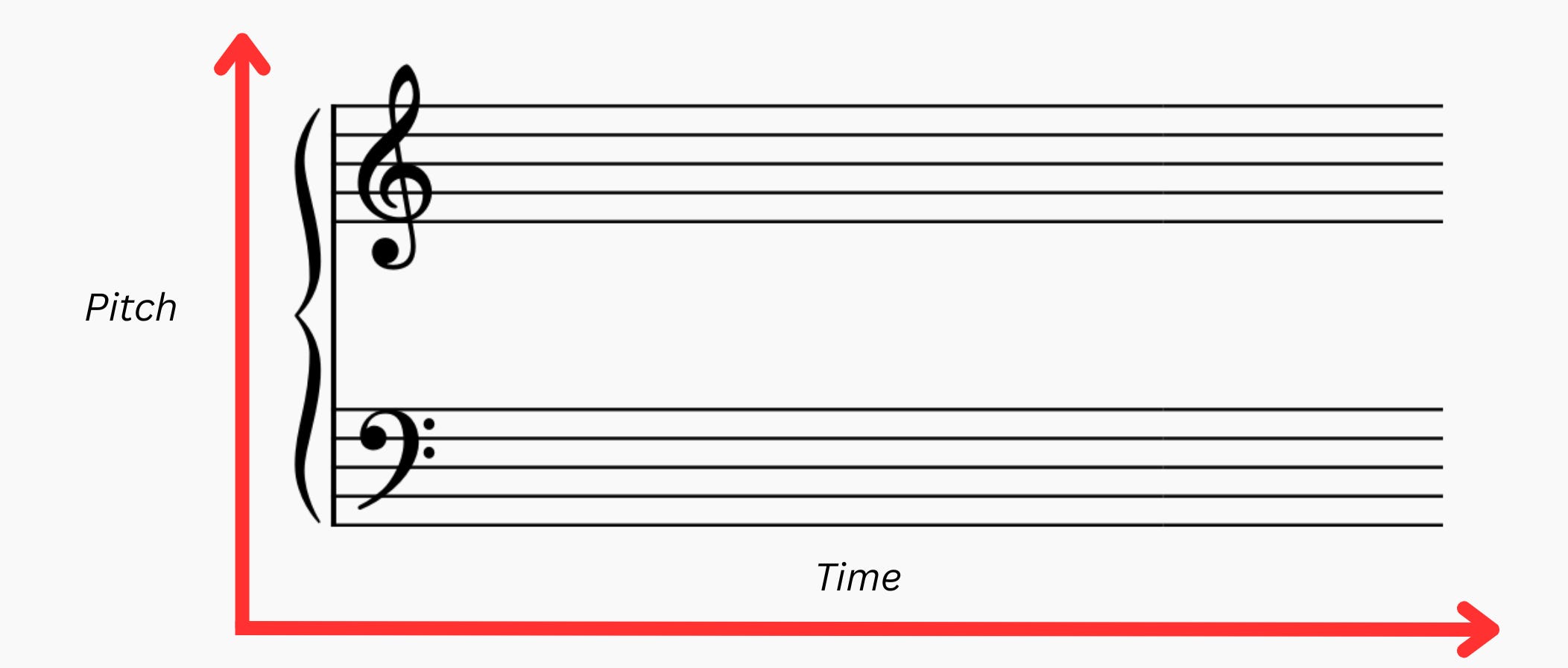
Seen this way, the ‘composition-space’ can be seen as a pair of axes delineating a set of potential arrangements of pitch in time. When we compose music, we are synthesising arrangements of pitch and time according to various logical and pattern-based conventions, such that we can think of music as a ‘geometry of sound’, or ‘architecture of sound’. For this reason, I have often remarked that I find the profession of music to be fundamentally very similar to that of architecture, since both domains involve the creative, but rule-governed synthesis of novel and logically sound arrangements within a ‘possibility-space’, either comprised of the three familiar dimensions of physical space, mass, etc., or time and pitch.
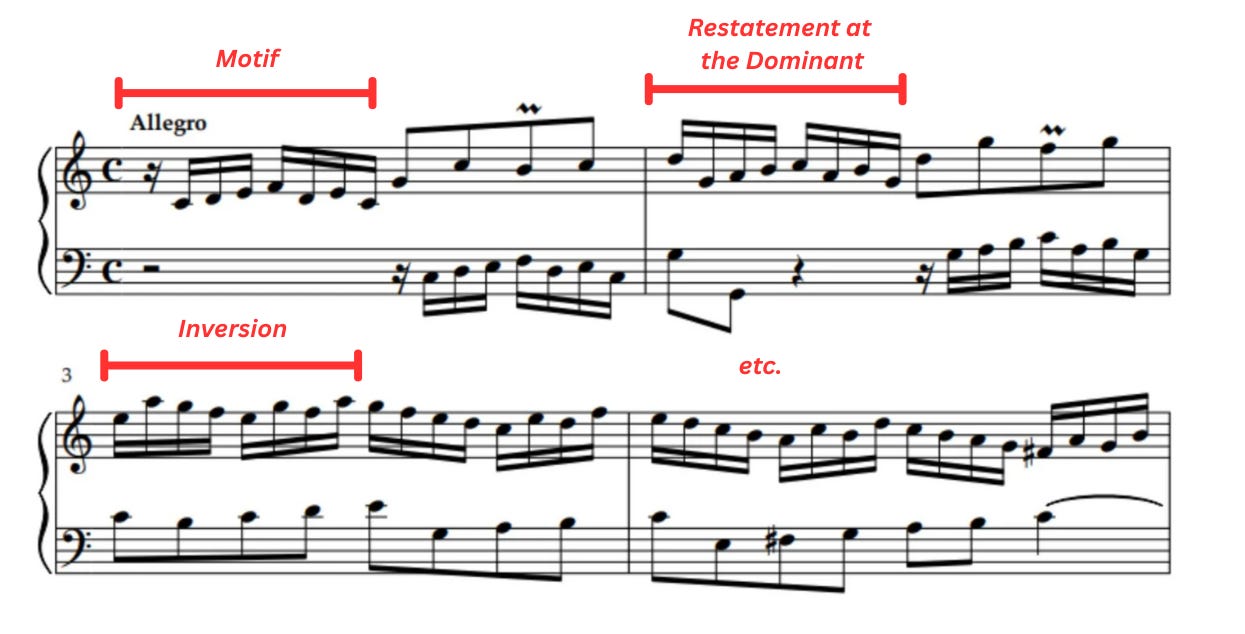
Often in music composition, we are attempting to generate elaborations upon a set of starting constituents; known as ‘variation’, or ‘motivic development’.
Consider a Bach invention: a single motif becomes the material for an entire piece. By elaborating upon a set of minimal components, the material remains logically related but continuously novel. (Bach’s First Invention in Two Parts, BWV 722)
Synthesis in Conceptual and Linguistic Domains
Similarly, language and thought evolve in part through taxonomising and ascribing identity to discrete and differentiable components of nature. In the actual domain of taxonomy, we make every effort to distinguish between categories of things, for instance, animal species. Sometimes the points of distinction are fuzzy or ambiguous, because at the level of granularity at which we operate in conventional speech, we are unable to adequately do justice to the actual granularity of the world, and our categories often end up servicing the requirements of functional utility as much as strict accuracy.
Furthermore, language evolves through new coinages, neologisms and portmanteaus, which are often explicit combinations of pre-existing concepts, and can be thought of as conceptual-syntheses. For instance, we could coin a new term through neologistic portmanteau this very moment: say, ‘neobiophonica’, or (‘new-life-sounds’), to refer to the sounds of new and emerging biological, or biomechanical life. Neologistic portmanteaus such as this enable us to say more with less, and condense meaning into a simple form, rather than having to elaborate upon the meaning of a given concept each time we converse. Thus, we are able to synthesise and perform conceptual analysis at ever greater levels of complexity using components that are fundamentally very simple, reducing their cognitive, informational or memory-load.
Conceptual syntheses such as this might seem exclusively additive, but they are arguably subtractive as well. Rather, than having to explain what ‘neobiophonica’ means in so many words, I have removed the need for elaboration and have reduced the concept to the simplest form in which it can possibly be stated.
As something of a tangent, I have wondered about the relationship between the subtractive dimension of increasing complexity as it pertains to negative-entropy. It seems that in multiple domains, whether biological and technological evolution, or conceptual evolution, we are filtering out superfluous noise as we crystallise around evermore optimal forms. Perhaps we might also relate this to von Förster’s understanding of science, in the sense that in achieving ever-greater complexity, we are distinguishing (‘dividing’, ‘splitting’) relevant from irrelevant components of a given system, where relevance is determined by integral components or functionality. By dividing and filtering, we remove noise and isolate essential structures.
Concluding Remarks
Examples of analysis and synthesis in action could be elaborated upon indefinitely. A comprehensive exposition would be beyond the scope of this article, but I aim to have provided a sufficient number of adequately illustrative examples. In doing so I hope to have shown why, for me, all of the aforementioned domains (philosophy, science, music, art, etc.) are interrelated and share commonalities in their fundamental epistemology and methodology. If one is interested in understanding the world, and engaging in novel and creative play with its elements, all of the aforesaid domains can be understood as subdomains of that broader pursuit.
I think I have strongly gravitated towards philosophy, and ultimately ended up specialising in this area, because philosophy is a kind of ‘meta-analytic’ or ‘meta-systematising’ endeavour, in the sense that philosophers do not merely seek to analyse, but seek to analyse ‘analysis’ itself; they do not merely seek to ‘systemise’ but to identify the properties that underpin ‘systemisation’ itself; something I hope to have shed some light upon here.
Ultimately, the practice of synthesis—across domains—is an expression of curiosity and engagement with the universe’s potentialities. It is playful yet rigorous, imaginative yet disciplined. It motivates my work and undergirds the act of creation. In this way, this very journal documents the alchemy of my own thought, showing how novelty emerges from the careful interplay of understanding and recombination, and offering a glimpse of the combinatorial richness of the mind in action.